


Your birthday comes around every year on the same date. Your metric birthday does not. It lands on one specific day, once in your whole life, on a date that has nothing to do with the month you were born in. For most people, that date is a complete surprise, and finding it feels like discovering a secret second birthday hidden in your calendar.
Your metric birthday is the day you reach a round number of days alive, and the most famous one is your 10,000th day. It arrives when you are about 27 years and 4 months old, on a date you would never guess without doing the math. In this guide I will explain what your metric birthday is, walk through every milestone worth knowing, show you how to find when yours falls, and share fun ways to celebrate it.
If you want the exact date right now, our free metric birthday calculator works it out in seconds from your birth date. For the step-by-step math and the leap year trap that catches most people, my guide to the metric birthday calculator covers the calculation in detail. This post is the explanation: what your metric birthday means, why people love it, and when each of your milestones falls.
Table of Contents:
- What Is Your Metric Birthday?
- The 10,000-Day Birthday:
- All the Metric Birthday Milestones:
- When Does Your Metric Birthday Fall?
- Why People Love Metric Birthdays:
- How to Celebrate Your Metric Birthday:
- Metric Birthday vs Golden Birthday vs Half Birthday:
- Fun Facts About Metric Birthdays:
- Frequently Asked Questions:
- Conclusion:
What Is Your Metric Birthday?
Your metric birthday is a milestone counted in days alive instead of years. Your regular birthday marks another year. Your metric birthday marks a round number of days, like 1,000, 5,000, or 10,000. Each one happens exactly once, on one specific date, and it never comes around again.
The name comes from the metric system, the same system that counts in tens, hundreds, and thousands. A metric birthday uses round numbers in base 10, so the milestones are 1,000 days, 5,000 days, 10,000 days, and so on. Some people also count round numbers of weeks, like 1,000 weeks, and round numbers of seconds, like one billion seconds. They are all metric birthdays, just measured in different units.
What makes your metric birthday special is that it belongs only to you. Everyone born on your birthday shares your birthday. Nobody else shares your metric birthday, because it depends on your exact birth date.
Days, Not Years:
The simplest way to think about it is this: your age in years counts birthdays, and your metric birthday counts days. You turn 27 on your 27th birthday. You turn 10,000 days old on your metric birthday, which lands about 4 months after that birthday. Both numbers describe the same life, but the metric one lands on a date nobody expects, which is half the fun.
The 10,000-Day Birthday:
The 10,000-day birthday is the metric birthday most people hear about first, and it is the one most worth celebrating. Ten thousand days is about 27.38 years, which works out to 27 years, 4 months, and a couple of extra weeks. If you are in your late twenties, yours is either coming up soon or just behind you.
Ten thousand is a satisfying number. It is the first five-figure day count of your life, and it arrives at an age when a regular birthday can start to feel routine. Your 27th birthday is one of many. Your 10,000th day happens once, on a random Tuesday or a Saturday in May, and that surprise is what makes it feel like a real occasion.
All the Metric Birthday Milestones:
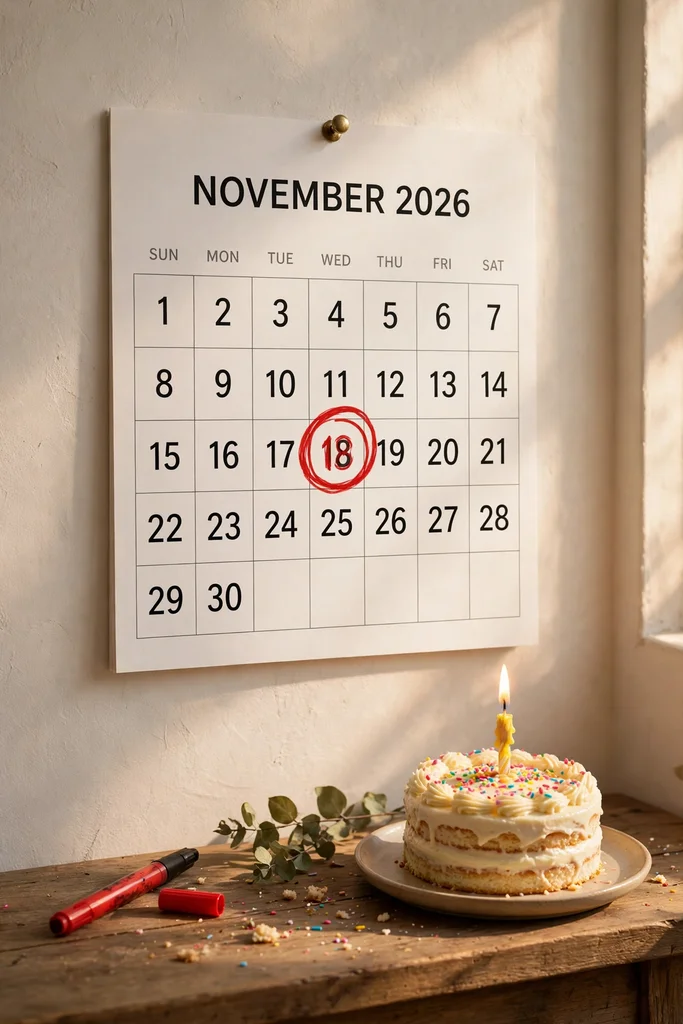
Your 10,000th day is the headline, but it is not the only metric birthday you get. Here are all the milestones worth knowing, from your first thousand days to your billionth second. I have worked out the dates for someone born on January 1, 2000, so you can see how they spread across a lifetime.
- 100 days: about 3 months old. Your very first metric milestone, usually marked by parents with a photo.
- 1,000 days: about 2 years and 9 months old. For someone born on January 1, 2000, it fell on September 27, 2002.
- 5,000 days: about 13 years and 8 months old. Born January 1, 2000, it fell on September 9, 2013, right at the start of the teenage years.
- 1,000 weeks (7,000 days): about 19 years and 2 months old. Born January 1, 2000, it fell on March 2, 2019.
- 10,000 days: about 27 years and 4 months old. Born January 1, 2000, it falls on May 19, 2027. This is the famous one.
- One billion seconds: about 31 years and 8 months old. Born January 1, 2000, it falls on September 9, 2031. One billion seconds is 11,574 days, 1 hour, 46 minutes, and 40 seconds.
- 15,000 days: about 41 years and 1 month old. Born January 1, 2000, it falls on January 25, 2041.
- 20,000 days: about 54 years and 9 months old. Born January 1, 2000, it falls on October 4, 2054.
- 25,000 days: about 68 years and 5 months old. Born January 1, 2000, it falls on June 12, 2068.
Notice how the milestones bunch up early and spread out later. You get three of them before your 20th birthday, then the gaps stretch to a decade or more. That is why the 10,000-day birthday gets the most attention: it is the big one that lands right in the middle of young adult life, when a surprise celebration is most welcome.
When Does Your Metric Birthday Fall?
Finding your own metric birthday takes one simple step: add 10,000 days to your birth date. That is the whole calculation. The only hard part is that months have different lengths and leap years add extra days, so you cannot just add 27 years and call it done. Adding 27 years to a birth date lands about 4 months early, and guessing from 365 days a year lands a full week late, because it skips the leap days.
The easy way is to let a tool do it. Enter your birth date in our free metric birthday calculator and it gives you the exact date in seconds, with your other milestones alongside it. If you like doing it by hand, my metric birthday calculator guide walks through the manual method, the leap year rule, and the mistakes to avoid.
Here are two quick examples so you can see the pattern. Someone born on January 1, 2000 reaches 10,000 days on May 19, 2027. Someone born on January 1, 1990 reached 10,000 days on May 19, 2017. The date is the same month and day, ten years apart, because both birth dates sit in the same place in the leap year cycle. Your own date will be different, and that is the point. It is yours alone.
What If Your 10,000th Day Already Passed?
If you are past 27 and a half, your 10,000th day is behind you, and that is fine. You still have milestones ahead. Check your billion-second birthday at about 31 years and 8 months, your 15,000th day at about 41, and your 20,000th day at about 54 years and 9 months. Most people have a metric birthday coming up within a few years, whatever their age. And if you missed your 10,000th day, celebrate it late. A belated metric birthday is still a metric birthday.
Why People Love Metric Birthdays:
Metric birthdays have a small but devoted following, and once you find your date, it is easy to see why. They solve a few real problems with regular birthdays, and they add a little surprise to the calendar.
A Date That Is Only Yours:
Your birthday is shared with millions of people. Your metric birthday is shared with almost nobody. It falls on a date that means nothing to anyone else, which makes it feel personal in a way a regular birthday never can. It is a milestone with your name on it, and only yours.
A Reason to Celebrate Between Birthdays:
Your metric birthday usually lands months away from your real birthday, right in the middle of an ordinary stretch of the year. That is the same charm as a half birthday: a surprise celebration in a month with nothing else going on. If your birthday falls near Christmas or another big holiday, your metric birthday is a day that is all yours.
A Milestone at Any Age:
Round-number birthdays like 30, 40, and 50 come once a decade. Metric birthdays come more often, at every age. A child gets a 1,000-day birthday. A teenager gets a 5,000-day birthday. An adult gets 10,000 days, a billion seconds, and 20,000 days. There is always a metric milestone on the horizon, whatever your age.
Fun to Share:
A metric birthday makes a great story. “I turn 10,000 days old on Wednesday” is a better conversation starter than “I turn 27.” Friends love it, it photographs well on a cake, and it gives you an excuse to gather people on a random date for no reason at all.

How to Celebrate Your Metric Birthday:
A metric birthday deserves a celebration, but it does not need a big party. The charm is that it is small, silly, and personal. Here are my favorite ways to mark the day.
Build the Party Around 10,000:
Put the number front and center. A cake with 10,000 candles is a fire hazard, so use number candles that read 10,000, or write the number in icing. Print a “10,000 days old” sign for photos, and hand out 10,000-themed party favors like gold coin chocolates. The number is the theme, and it does the work for you.
Keep the Gathering Small:
Invite your closest people, not the whole address book. A metric birthday works best as a dinner with friends, a picnic, or a night in with cake and a movie. The small scale is the point: it feels like a secret celebration, not a production.
Make a Time Capsule:
Write a letter to yourself to open on your next metric milestone, like your billion-second birthday or your 20,000th day. Add a photo from today, a list of your favorite things, and a prediction about where you will be. Seal it, date it, and put it somewhere safe. Future you will love it.
Metric Birthday Gift Ideas:
Gifts are not expected, but a small one on theme is a lovely touch. A star map of the night sky on your metric birthday, a custom print with your birth date and your 10,000th day, or a donation of 10,000 cents to a charity you love all fit the day. Keep it playful and personal.
Metric Birthday vs Golden Birthday vs Half Birthday:
Metric birthdays are one of three fun alternative birthdays people celebrate, and they are easy to mix up. Here is how they differ.
- Metric birthday: the day you reach a round number of days alive, like 10,000 days. It happens once, on one specific date, at about 27 years and 4 months old.
- Golden birthday: the birthday when your age matches your birth date, like turning 25 on the 25th. It happens once, in a year you can work out from your birth day.
- Half birthday: the date six months after your birthday, every year. It is a yearly mini-celebration, not a once-in-a-lifetime date. My guide to what a half birthday is explains the 6-month rule and how to find yours.
You can celebrate all three. They do not compete with each other, and they do not replace your real birthday. They just give you more excuses to eat cake, which is never a bad thing.
Fun Facts About Metric Birthdays:
A few numbers worth knowing before you tell your friends about your metric birthday.
- 10,000 days is 27.38 years, or 1,428 weeks and 4 days. Those 4 extra days are why your metric birthday always falls four weekdays after your birth weekday.
- One billion seconds is about 31.69 years, or 11,574 days, 1 hour, 46 minutes, and 40 seconds. It is often called the “metric birthday” too, because a billion is the roundest number of all.
- Your 1,000th day falls when you are about 2 years and 9 months old, which means every adult has already had at least one metric birthday.
- If you were born on January 1, 2000, your 10,000th day is May 19, 2027, your billionth second is September 9, 2031, and your 20,000th day is October 4, 2054. Three celebrations, already on the calendar.
Frequently Asked Questions:
What is a metric birthday?
A metric birthday is the day you reach a round number of days alive, like 1,000, 5,000, or 10,000 days. The most famous one is the 10,000-day birthday, which falls at about 27 years and 4 months old. Unlike a regular birthday, each metric birthday happens once, on one specific date.
When is my metric birthday?
Add 10,000 days to your birth date. For example, someone born on January 1, 2000 reaches 10,000 days on May 19, 2027. Our metric birthday calculator works out your exact date in seconds.
How old are you on your metric birthday?
About 27 years and 4 months old for the 10,000-day birthday, or about 31 years and 8 months for the one-billion-second birthday. The exact age in years, months, and days depends on your birth date and the leap years in between.
What is a billion-second birthday?
A billion-second birthday is the day you reach one billion seconds alive, which is 11,574 days, 1 hour, 46 minutes, and 40 seconds after your birth. It falls at about 31 years and 8 months old, and it is sometimes called a metric birthday too.
Is a metric birthday a real thing?
It is a real date on the calendar, and people have celebrated it for decades, but it is not an official holiday. It is a fun, informal milestone, like a half birthday or a golden birthday. No permission needed.
What if my 10,000th day already passed?
Celebrate it late, or look ahead to your next milestone. Your billion-second birthday falls at about 31 years and 8 months, your 15,000th day at about 41, and your 20,000th day at about 54 years and 9 months. There is always another metric birthday coming.
Also Read: Metric Birthday Calculator: Find Your 10,000-Day Birthday
Conclusion:
Your metric birthday is a date only you have, a round number of days alive that lands once and never repeats. Find your 10,000th day, mark it on your calendar, and celebrate it however you like. It is your milestone, and it is worth a little cake.
