


A friend texted me last week with a screenshot and one excited line: I turn 10,000 days old next month. I had never thought about my age in days before, and I have to admit I was hooked right away. Your 10,000th day is a real date on the calendar, it only happens once, and most of us walk right past it without ever knowing.
A metric birthday is the day you reach a round number of days alive, and the most famous one is 10,000 days. It lands at about 27 years and 4 months, on a date that has nothing to do with your actual birthday. A metric birthday calculator finds that date for you in seconds. Just enter your birth date, and it works out the exact day, so you can mark it, celebrate it, or simply enjoy knowing it. You can try ours right now with our birthday metric calculator.
In this guide, I will show you what a metric birthday is, which day milestones are worth knowing, how to work out your own date by hand, how to use a metric birthday calculator to find yours in seconds, and a few fun ways to celebrate when the day arrives.
What Is a Metric Birthday?

A metric birthday is a milestone counted in days instead of years. Your regular birthday marks another year, but a metric birthday marks a round number of days alive, like 1,000, 5,000, or 10,000. The name is a little playful, since days are not really a metric unit, but the idea is simple. Count your life in neat, round numbers and celebrate when you hit one.
The 10,000-day birthday is the one most people hear about first. Ten thousand days is about 27.38 years, or 1,428 weeks and 4 days, which works out to 27 years, 4 months, and a couple of extra weeks. That puts it right in your late twenties, a few years into adult life, which makes it a lovely moment to look back and celebrate how far you have come.
What I love most is that each one belongs only to you. Your birthday falls on the same date every year, but your 10,000th day falls on one specific date, once, and it will never come around again. It even lands on a different day of the week than the one you were born on. Because 10,000 days is 1,428 weeks plus 4 days, your metric birthday always falls four weekdays after your birth weekday. If you were born on a Monday, you turn 10,000 days old on a Friday. A metric birthday calculator turns that count into a date you can put in your calendar.
If you are curious how many days you have lived so far, our age calculator shows your total days lived along with your age in years, months, and weeks. It is a fun first step before you find your next milestone.
Metric Birthday Milestones: The Days Worth Knowing
Ten thousand days gets all the attention, but it is far from the only metric birthday. Every round number has its own moment, and some of them arrive at ages that make them perfect for a small celebration. Here are the milestones I keep coming back to, with the dates for someone born on January 1, 2000, so you can see how they spread across a lifetime. If you want your own dates rather than the example ones, a metric birthday calculator will work them all out in seconds.
| Milestone | About how old you are | Date if born January 1, 2000 |
|---|---|---|
| 1,000 days | 2 years, 8 months | September 27, 2002 |
| 5,000 days | 13 years, 8 months | September 9, 2013 |
| 7,777 days | 21 years, 3 months | April 17, 2021 |
| 10,000 days | 27 years, 4 months | May 19, 2027 |
| 11,111 days | 30 years, 5 months | June 3, 2030 |
| 15,000 days | 41 years | January 25, 2041 |
| 20,000 days | 54 years, 9 months | October 4, 2054 |
| 25,000 days | 68 years, 5 months | June 12, 2068 |
A few of these have their own charm. The 1,000-day milestone arrives when a child is about 2 years and 8 months old, which makes it a sweet one for parents to mark with a photo. Five thousand days lands in the early teens, at about 13 years and 8 months, and it is a fun first milestone for a teenager to work out on their own.
The repeating-digit milestones are my favorites. Seven thousand seven hundred seventy-seven days is exactly 1,111 weeks, so it falls on the same day of the week you were born on. Eleven thousand one hundred eleven days arrives about five months after your 30th birthday, which makes it a lovely second celebration once the big 30 party is over.
And if your 10,000th day has already passed, do not worry. Your 15,000-day and 20,000-day birthdays are still ahead of you, and the 20,000-day mark is a wonderful one to plan for, since it is exactly double the big one.
How to Work Out Your Metric Birthday by Hand
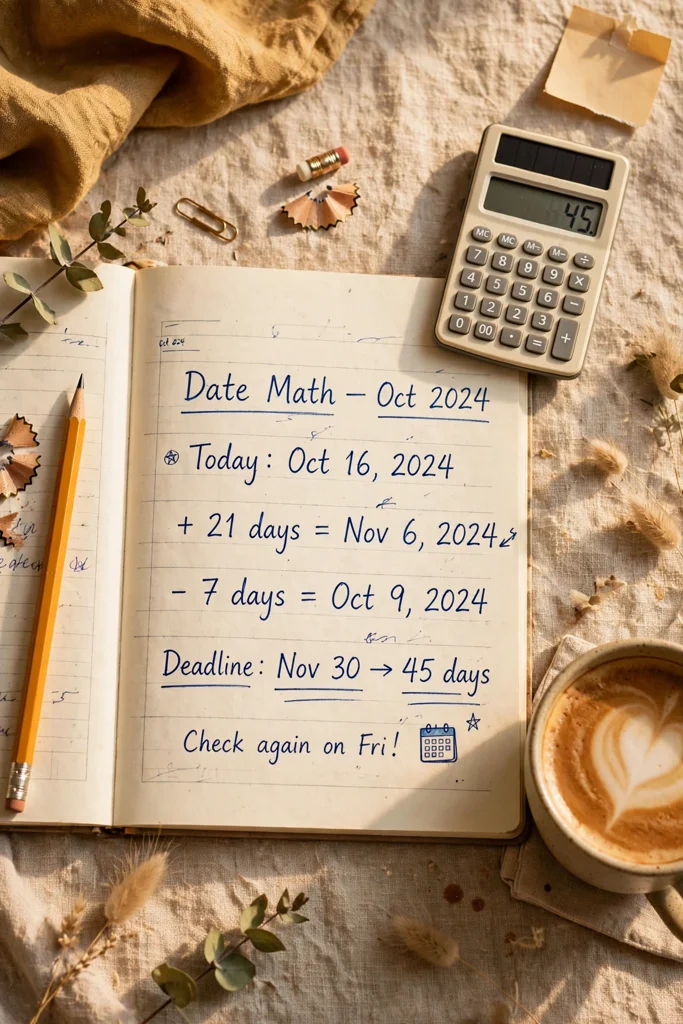
The math behind a metric birthday is simple once you know the trick. The formula is just your date of birth plus 10,000 days. The only hard part is that months are different lengths and leap years add extra days, so you cannot just add 27 years and call it done. Here is the method I use, with a worked example you can check. If you would rather skip the arithmetic, a metric birthday calculator does the same steps in one go.
Worked Example: Born January 1, 2000
Step 1: Count the whole years. From January 1, 2000 to January 1, 2027 is 27 years. That is 27 times 365, which is 9,855 days.
Step 2: Add the leap days. February 29 falls in 2000, 2004, 2008, 2012, 2016, 2020, and 2024, which adds 7 days and brings the total to 9,862 days.
Step 3: Find what is left. Ten thousand minus 9,862 leaves 138 days still to count from January 1, 2027.
Step 4: Walk through the months. January has 31 days, February has 28 in 2027, March has 31, and April has 30. That uses up 120 days and leaves 18 days into May.
Step 5: Read off the date. January 1, 2027 plus 138 days is May 19, 2027. A quick check confirms it: 9,862 plus 138 is exactly 10,000.
Two More Examples to Check Your Math
Born June 15, 1995: add 10,000 days and you land on October 31, 2022, at 27 years, 4 months, and 16 days old. If that date feels familiar, it is Halloween, which is a pretty perfect day for a metric birthday party.
Born February 14, 2000: add 10,000 days and you land on July 2, 2027, a Friday, at 27 years, 4 months, and 18 days old. A summer Friday is a wonderful day to celebrate.
Three Mistakes That Move the Answer
The most common mistake is using 365 days for every year. Divide 10,000 by 365 and you get 27 years and 145 days, which lands a full week late because it skips the leap days. Always add days to a real calendar date instead of converting through years.
The second mistake is treating “27 years and 4 months” as exact. Add 27 years and 4 months to January 1, 2000 and you get May 1, 2027, which is 18 days before the real milestone. The true age always includes an extra 15 to 18 days on top of the 4 months.
The third mistake is mixing up the day-counting convention. Most calculators count your birth date as day 0, just as you are 0 years old until your first birthday. If you count your birth date as day 1 instead, every milestone lands one day earlier. Neither way is wrong, but pick one and use it for every milestone.
Leap years are the reason all of this matters. Under the Gregorian calendar, a year is a leap year if it is divisible by 4, except for century years, which must also be divisible by 400. That is why 2000 was a leap year and 2100 will not be. The Royal Museums Greenwich has a clear explanation of the leap year rule if you want to check any year.
If you would rather check your hand calculation against a second tool, timeanddate.com has a date calculator that adds any number of days to a date. Or skip the hand math entirely and use our metric birthday calculator, which handles the leap years for you.
How to Use the Metric Birthday Calculator
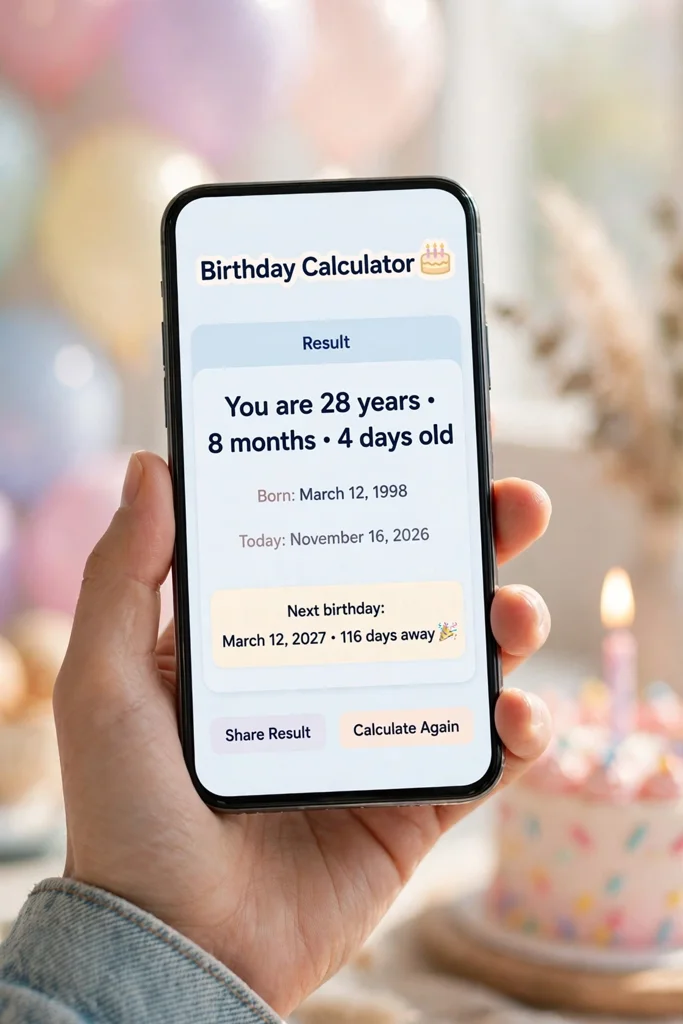
Doing the math by hand is satisfying, but a metric birthday calculator gets you the answer in about ten seconds, and it never miscounts a leap year. Here is how to use ours.
- Open our birthday metric calculator.
- Enter your date of birth.
- Read your results. The metric birthday calculator shows your total days lived, along with your age in weeks, months, and hours, plus the days left until your next birthday and the day of the week you were born on.
- Check your milestones. Compare your total days lived with the milestone list above to see which metric birthdays are coming up next.
The metric birthday calculator is free, and you do not need an account or any extra details. It works just as well for a friend or family member, so it is a fun one to try at a party. Enter a few birth dates and see whose 10,000th day is closest.
If you enjoy day-count milestones, your half birthday is another one worth finding. Our half birthday calculator tells you the date exactly six months after your birthday, which is perfect for a summer party if you have a winter birthday, or the other way around.
Fun Ways to Celebrate a Metric Birthday
A metric birthday is not a date anyone else will remember for you, which is exactly what makes it fun. It is your own private milestone, so you can celebrate it any way you like. Once a metric birthday calculator has given you the date, the fun part starts. Here are a few ideas I love.
Walk 10,000 steps on the day
Plan a long walk with a friend, a hike, or a wander around a neighborhood you have never explored. It is a simple way to mark the number, and you will have earned the cake by the end of it.
Build a 10,000-day photo timeline
Pick one photo from each year of your life, or one from roughly every 1,000 days, and lay them out in order. You will see how much has changed in 27 years, and it makes a wonderful display at a party or a lovely post to share online.
Throw a 10,000-day party
Keep it small and let the number be the theme. Gold “10,000” balloons, a cake with the number on top, and a playlist of songs from the year you were born are all you need. If you want games for a small gathering, our birthday activities for adults has plenty of ideas that work for mixed-age groups.
Write a letter to your 20,000-day self
Write a letter about where you are now and what you hope for the next 10,000 days. Seal it, write your 20,000-day date on the envelope, and put it somewhere safe. It is a small gift to your future self.
Make a day-count timeline of big moments
Work out the day number of your big life moments, like your first day of school, graduation, or your first job. Each one is just the event date minus your birth date. It is a fun way to see your life in a completely different unit, and it makes a great conversation starter.
Plan your next milestone
Once you know your 10,000-day date, find your 11,111-day and 15,000-day dates too and put them in your calendar. Future you will be glad you did, and you will never miss another metric birthday.
Frequently Asked Questions:
What is a metric birthday?
A metric birthday is a milestone counted in days alive instead of years. The best-known one is turning 10,000 days old, which happens at about 27 years and 4 months. Unlike a birthday, each metric birthday happens once, on its own date.
How old are you when you turn 10,000 days old?
You are 27 years, 4 months, and between 15 and 18 days old, depending on your birth date. As a decimal, 10,000 days is 27.38 years. You can find your exact date with a metric birthday calculator.
How many years is 10,000 days?
About 27.38 years, using the average Gregorian year of 365.2425 days. If you divide by 365 instead, you get 27.40 years, which is slightly off because it ignores leap days.
What day of the week will my 10,000th day be?
It will be four weekdays after the weekday you were born on, because 10,000 days is 1,428 weeks plus 4 days. If you were born on a Monday, you turn 10,000 days old on a Friday. You can check your birth weekday with our day of week calculator.
Does the day I was born count as day 1?
By the usual convention, no. Your birth date counts as day 0, just as you are 0 years old until your first birthday. If you count it as day 1, your 10,000th day is your birth date plus 9,999 days, which is one day earlier.
What if my 10,000th day already passed?
It still counts, and plenty of people celebrate it late once they find out the date. Run your birth date through a metric birthday calculator to find your 11,111-day, 15,000-day, and 20,000-day birthdays, which are all still to come.
When do I turn 20,000 days old?
At about 54 years and 9 months. Add 20,000 days to your birth date for the exact day. Someone born on January 1, 2000 turns 20,000 days old on October 4, 2054.
How do I find my 10,000th day in a spreadsheet?
Spreadsheets store dates as day numbers, so the formula is simple. Put your birth date in cell A1, then enter =A1+10000 in another cell and format it as a date. The result is your 10,000-day birthday. You can also use timeanddate.com’s date duration calculator to count the days between two dates, or use a metric birthday calculator if you would rather skip the formula.
Conclusion:
Your 10,000th day is a once-in-a-lifetime date, and now you know exactly how to find it. Try our metric birthday calculator, mark the day in your calendar, and give yourself a reason to celebrate that nobody else shares.
Also Read: Half Birthday Calculator

1 thought on “Metric Birthday Calculator: Find Your 10,000-Day Birthday”