

Your birthday is six months away and you want the exact date of your half birthday. Good news: you can work it out by hand in under a minute, with nothing more than a calendar and the three methods in this guide.
I have done this math for my own birthday, for my kids, and for friends who wanted a mid-year excuse to celebrate. Most dates are simple and only a few need extra care. This guide shows you three ways to calculate your half birthday: by counting forward on a calendar, with the quick add-six rule, and with a full worked example you can follow step by step.
If you would rather skip the math, our free half birthday calculator gives you the exact date in seconds. My full half birthday calculator guide walks through the tool itself, while this post is all about doing it yourself.
Method 1: Count Forward on a Calendar:
This is the simplest way to learn how to calculate your half birthday, and it needs no math at all. If you can count to six, you can do this one. It is my favorite method for kids and for anyone who likes to see the answer on a real calendar instead of trusting a formula.
Count Six Months with Your Fingers:
Start on your birth month and count forward six months, one month at a time. Say you were born in March. Count April on one finger, May on the next, then June, July, August, and September. Your half birthday falls in September, on the same day as your birthday. Born March 10? Your half birthday is September 10.

Check It on a Wall Calendar:
Once you have counted to your target month, flip to that month and find the same day number as your birthday. Circle it. That circled date is your half birthday. Born June 20? Circle December 20. Born November 15? Count past December into the next year and circle May 15.
The one catch is the year rollover. If your birthday falls between July and December, counting six months forward takes you into the next calendar year. If the day you land on does not exist in the target month, use the last day of that month instead. I cover those tricky dates in Method 2.
Method 2: The 6-Month Rule (Add 6, Keep the Day):
This is the fastest way to learn how to calculate your half birthday once you know it. It is the same math as the calendar method, just done with numbers instead of counting on your fingers.
The Add-6 Shortcut:
Here is the whole method in four easy steps:
- Write down your birth month as a number. January is 1 and December is 12.
- Add 6 to that number. March (3) plus 6 is 9, which is September. October (10) plus 6 is 16.
- If the answer is more than 12, subtract 12 and move into the next year. October plus 6 is 16, so subtract 12 to get April of the following year.
- Keep the same day of the month. A March 10 birthday becomes a September 10 half birthday.
That is it. Add six months, keep the day, and slide back to the last day of the month when the day does not exist. Step 4, the month-end rule, is the only step that trips people up. I cover it in full below.
The Month-Pair Cheat Sheet:
Find your birth month in this table. Your half birthday falls in the month across from it, on the same day number.
| Your birthday is in | Your half birthday is in |
|---|---|
| January | July, same year |
| February | August, same year |
| March | September, same year |
| April | October, same year |
| May | November, same year |
| June | December, same year |
| July | January, next year |
| August | February, next year |
| September | March, next year |
| October | April, next year |
| November | May, next year |
| December | June, next year |
The pattern is easy to remember: birthdays from January through June have half birthdays in the same year, and birthdays from July through December have half birthdays in the following year.
Month-End Edge Cases: August 31, February 29, and the 31sts:
Most birthdays are easy, but a few dates need extra care. The problem is always the same: the month six months later is shorter than your birth day. If your birth day does not exist in the target month, use the last day of that month instead.
Born August 31. Six months after August is February, and February never has 31 days. So your half birthday is the last day of February: February 28 in a normal year, or February 29 in a leap year. Someone born on August 31, 2001 has a half birthday on February 28, 2002, while someone born on August 31, 1999 has one on February 29, 2000. The same rule applies to August 29 and August 30 birthdays.
Born February 29. This one is easy, and it is good news for leap day babies. Six months after February is August, and August always has 31 days. Your half birthday is August 29 every single year, no adjustments needed. It is one of the few birthday dates that never moves around.
Born on the 31st of other months. The same slide-back rule applies. Born March 31, your half birthday is September 30. Born October 31, it is April 30. Born December 31, it is June 30. Born May 31, it is November 30. January 31 and July 31 never need adjusting, because both months have 31 days.
How leap years fit in. Leap years only matter when your half birthday lands in February, which happens when you were born in August. A leap year is a year divisible by 4, except for century years that are not divisible by 400, which is why 2000 was a leap year but 1900 and 2100 are not. The next leap day falls on February 29, 2028. You can read the full leap year rules at timeanddate.com, but just check whether the target February is a leap year, and pick February 29 if it is, February 28 if it is not.
Method 3: A Worked Example Walkthrough:
Methods 1 and 2 give you the rules. This method shows you the rules in action, with four complete examples you can follow line by line. Pick the example closest to your own birthday and follow the same steps. If you want to learn how to calculate your half birthday with total confidence, working through one example like these is the best way to do it.
Example 1: Born March 10, 1998:
This is the easy case, and it is the one most birthdays look like. Start with March, month 3. Add 6 to get 9, which is September. The answer is not more than 12, so the half birthday falls in the same year, 1998. Keep the same day, 10. Your first half birthday is September 10, 1998. Check it with the calendar method: count forward from March to September and land on September 10. Both methods agree. The gap is 184 days, a good reminder that a half birthday is six calendar months, not a fixed number of days.
Example 2: Born October 4, 2001 (Year Rollover):
This example shows the year rollover, the step most people forget. Start with October, month 10. Add 6 to get 16. That is more than 12, so subtract 12 to get 4, which is April, and move into the next year, 2002. Keep the same day, 4. Your first half birthday is April 4, 2002. If you had forgotten the rollover and written April 4, 2001, you would have picked a date six months before the birthday. The gap here is 182 days.
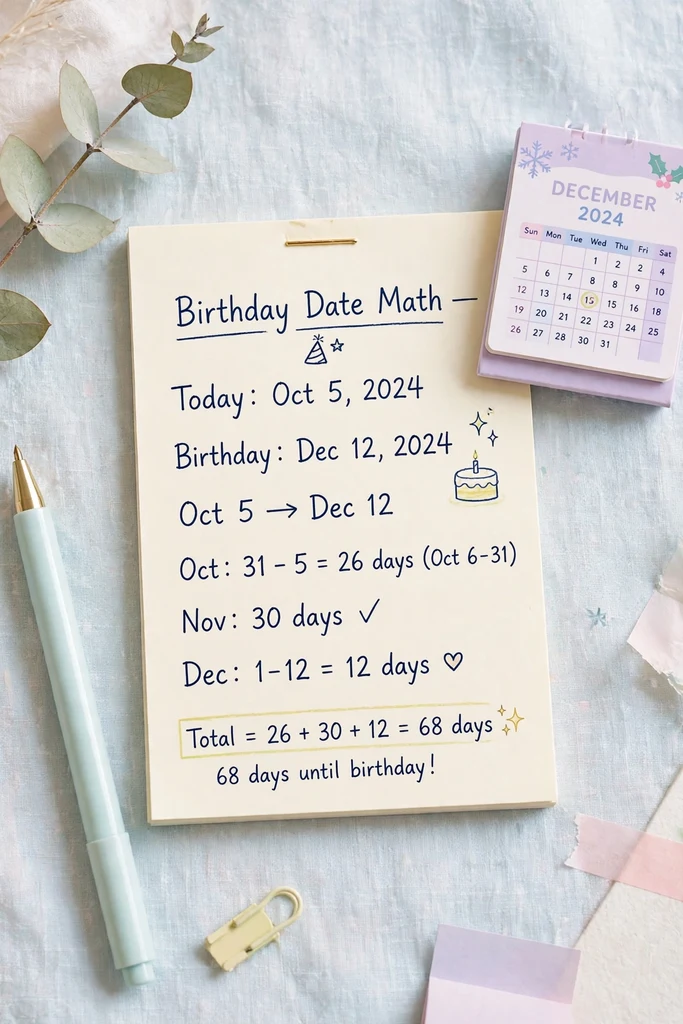
Example 3: Born August 31, 2001 (Month-End Fix):
This is the tricky one, so follow it slowly. Start with August, which is month 8. Add 6 to get 14. That is more than 12, so subtract 12 to get 2, which is February, and move into the next year, 2002. Now try to keep the same day, 31. February 2002 has only 28 days, so day 31 does not exist. Slide back to the last day of the month: February 28, 2002. If the same person had been born on August 31, 1999, the target February would be February 2000, a leap year, so the answer would be February 29, 2000. Always work out the month-end fix in the target year, never in the birth year.
Example 4: Born February 29, 2000 (Leap Day Baby):
Leap day babies get the simplest half birthday of all. Start with February, month 2. Add 6 to get 8, which is August. The answer is not more than 12, so the half birthday falls in the same year, 2000. Keep the same day, 29. August always has 31 days, so day 29 exists with no fix needed. Your first half birthday is August 29, 2000, and it stays August 29 every year after that. The gap is 182 days.
Find Your Next Half Birthday, Not Just the First One:
So far we have found first half birthdays, the ones right after birth. What you usually want is your next half birthday, the one coming up this year or next. Work out your half birthday month and day, ignoring the year. Then test that month and day in the current year. If it is today or still in the future, that is your next half birthday. If it has already passed, use the same month and day in the following year.
Try it with a real example. Say you were born on November 15. Your half birthday month and day are May 15. If today is March 2027, May 15, 2027 is still ahead of you, so that is your next half birthday. If today is June 2027, May 15 has already passed, so your next half birthday is May 15, 2028. Always start from your original birthday, never from a half birthday you already worked out. Adding six months to a clamped date like February 28 can drift by a day. If you want to learn more, my guide to what a half birthday is covers the meaning, the rules, and fun ways to celebrate.
Common Mistakes to Avoid:
Counting Exactly 182 Days:
This is the most common mistake, and it looks sensible until you check the numbers. A half birthday is six calendar months after your birthday, not 182 days after it. The gap works out to 181 to 184 days. Take January 10, 2026. Six months later is July 10, 2026, a gap of 181 days. Add 182 days instead and you land on July 11, one day late. Take March 10, 1998. Six months later is September 10, a gap of 184 days. Add 182 days and you land on September 8, two days early. The calendar month convention at Calendarz agrees. Stick with months, not days.
Adding 6 Months to an Already Clamped Date:
This trap only bites people born on month-end dates, but it bites hard. Say you were born on August 31 and your half birthday is February 28. If you add six months to February 28, you land on August 28, which is wrong. Your half birthday is anchored to your original birthday, August 31, so the next one is August 31 again. The clamped date is a one-time fix for a short month, not a new starting point. Always go back to your original birth date for every calculation.
Forgetting the Year Rollover:
If your birthday falls between July and December, your half birthday lands in the next calendar year. It is easy to write down the right month and day with the wrong year. October plus six is April of the following year, November plus six is May of the following year, and December plus six is June of the following year. The month-pair table in Method 2 shows the year for every month. If you want a second opinion, the half birthday calculator will confirm your answer in seconds.
Check Your Answer in Seconds:
Once you have learned how to calculate your half birthday by hand, check it once. Type your birth date into our free half birthday calculator and compare the result with your hand calculation. If they match, you did the math right. If they do not match, look for a missed year rollover, a skipped month-end fix, or a 182-day count instead of a calendar-month count. My half birthday calculator guide shows the tool step by step, and my guide to age in days shows a similar hand method.
Frequently Asked Questions:
What is the fastest way to calculate my half birthday?
Add 6 to your birth month number and keep the same day. If the answer is more than 12, subtract 12 and move into the next year. If the day does not exist in the target month, use the last day of that month. That is the whole method.
What if my birthday is August 31?
Your half birthday is the last day of February: February 28 in a normal year, or February 29 in a leap year. The same rule applies if you were born on August 29 or August 30.
What if I was born on February 29?
Your half birthday is August 29, every year. Six months after February is August, and August always has 31 days, so no adjustment is ever needed.
Is a half birthday exactly 182 days after my birthday?
Not exactly. A half birthday is six calendar months after your birthday, and that gap works out to 181 to 184 days. Counting a fixed 182 days can land a day or two away from the real date.
How do I find my next half birthday if this year’s already passed?
Work out your half birthday month and day, then test that date in the current year. If it is today or still in the future, that is your next half birthday. If it has already passed, use the same month and day in the following year.
Do I need a calculator to find my half birthday?
No, you can do it by hand with any of the three methods in this post. A calculator just makes it instant and removes any doubt about leap years and short months.
Also Read: Birthday Activities for Adults
Conclusion:
Learning how to calculate your half birthday by hand is easier than it looks. Count six months on a calendar, add six to the month number, or follow a worked example, and you will have your date in under a minute. Mark it on your calendar and enjoy a small mid-year celebration.
